Strategies for Building a Profitable Retreat Business
Insights on pricing, marketing, hospitality, and the business behind transformational retreats. By Leni Cavazos.
Why Most Retreats Lose Money: 7 Profit Leaks to Fix
Why Most Retreats Lose Money: 7 Profit Leaks to Fix
Most retreats lose money, and not because the market is bad. They lose money because the business model was built on inspiration rather than architecture. The seven profit leaks are predictable, auditable, and fixable, and every one of them traces back to a decision made before the first guest booked. This is a strategist walkthrough of where the money goes, and how to get it back.
Why Retreats Fail Financially
A retreat is a high-cost, high-complexity product with a narrow enrollment window. Miss on pricing, venue, or enrollment infrastructure and the math stops working. That is not a market failure, it is a design failure.
The retreats that make money are not special. They are simply the ones where the business was architected before the guest experience was.
The 7 Profit Leaks
Leak 1: Pricing Built on Fear
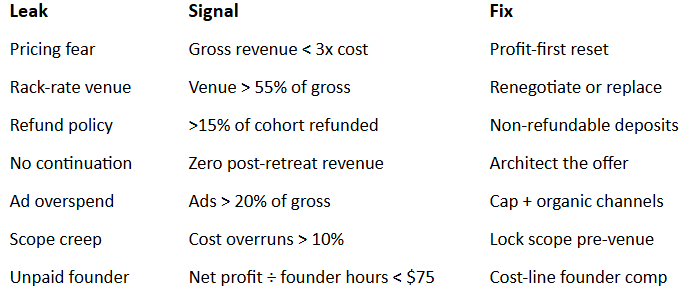
The most common failure. Retreat leaders routinely price 30–50% below what the cost structure requires. The fix is profit-first pricing, starting with margin, working backward through cost, and landing on a number that produces a business.
Leak 2: Rack-Rate Venue Contracts
First quotes from venues are almost never the best rate. Professional hospitality operators negotiate 15–35% off. Retreat leaders who accept the first number quietly surrender that margin, sometimes the entire profit of the cohort.
Leak 3: Refund Policies That Cost More Than They Save
Generous refund policies feel kind and destroy margin. Every refunded seat that cannot be resold before the venue cutoff is pure loss. The fix is non-refundable deposits, transferable seats, and clear policy language.
Leak 4: No Continuation Offer
A retreat without a back-end offer captures a fraction of its lifetime value. The most profitable retreat businesses earn 60–70% of their cohort revenue after the retreat ends. Leaders who skip the continuation offer leave most of the business on the table.
Leak 5: Uncapped Marketing Spend
First retreats often overspend on ads to compensate for the absence of an enrollment system. The result is a cohort that filled but did not profit. Cap ad spend at 15% of projected revenue.
Leak 6: Scope Creep On-Site
Small additions, an extra excursion, upgraded welcome kits, a guest speaker, compound. Each one feels like a small generosity. Together they consume 5–15% of margin without a corresponding price increase.
Leak 7: Unpaid Founder Time
A retreat netting $8,000 after 400 hours of founder work is paying the founder $20 an hour. That is not a business. Founder compensation must be treated as a cost line, not a profit residual.
The Audit Matrix
What a Profitable Retreat Actually Costs
For a 10-guest, 5-night retreat at mid-tier pricing:
- Gross revenue at $4,500/guest: $45,000
- Fully-loaded cost (all leaks fixed): $27,000
- Founder compensation: $6,000
- Net profit: $12,000
- Net margin: 27% after founder compensation, 40% before
The leaks below are what the profitable retreat does not pay:
- $5,000 in pricing fear
- $4,000 in venue overspend
- $2,500 in refund overspend
- $15,000+ in missed continuation revenue
- $3,000 in ad overspend
- $2,000 in scope creep
- $6,000 in unpaid founder time
Total leaked: $37,500 on the same cohort.
Real Example
Brent McCann was on track to lose $10,000 on his men's retreat. One week of restructuring, repriced the retreat, renegotiated the venue, added a continuation offer, and the same retreat closed at $17,000 in profit. A $27,000 swing on the same cohort. The margin was always there. The leaks were closed.
Frequently Asked Questions
Is it possible to fix all 7 leaks before the next cohort?
Yes. The audit takes two hours. The implementation takes one to three weeks.
Which leak should I fix first?
Pricing. It is the highest-leverage and the fastest to change. Everything else becomes easier after pricing is correct.
What if I've already sold the next cohort at the wrong price?
Honor those bookings at the original price. Apply new pricing to new bookings. Do not retroactively change.
How common is "no continuation offer"?
Very common. Close to 80% of retreat leaders launch their first retreat without a continuation offer. It is the single biggest missed opportunity in the category.
Can marketing rescue a retreat with these leaks?
No. Marketing amplifies what already works. It cannot rescue a broken business model.
Want to audit your retreat for all 7 leaks in one conversation? Book a strategy call

Ready to Build a Retreat Business That Matches Your Vision?
Join the free Sold Out & Profitable Masterclass and learn the framework behind retreats that fill and profit consistently.