Strategies for Building a Profitable Retreat Business
Insights on pricing, marketing, hospitality, and the business behind transformational retreats. By Leni Cavazos.
Paid Ads for Retreats: What Works and What Wastes Budget
Paid Ads for Retreats: What Works and What Wastes Budget
Paid ads for retreats work when the organic offer is already proven and the ads amplify it. They fail when leaders try to use ads to rescue weak positioning, unclear pricing, or a broken sales page. This guide walks through the platforms that work, the structure that converts, and the mistakes that waste budget. Budget benchmark: 8–15% of projected gross revenue.
What Are Paid Ads for a Retreat Business?
Paid ads for a retreat business are paid media placements, typically Meta (Facebook/Instagram) and Google, designed to drive qualified traffic to a retreat sales page, lead magnet, or masterclass.
Which Platforms Work for Retreats
Meta (Facebook and Instagram)
The dominant channel for retreat advertising. Strong visual creative, precise interest-based targeting, and retargeting capability. Best for retreats targeting consumers, wellness leaders, coaches, entrepreneurs.
Google Search
Useful for keyword-driven retreat searches, "women's retreat Mexico," "business retreat Bali." Best for retreats with clear, searchable positioning.
YouTube
Strong for video-heavy retreat brands. Best as a retargeting channel after organic or Meta has produced initial traffic.
Expensive per click but high-intent for corporate or executive retreats. Not recommended for consumer retreats.
TikTok
Effective for younger-audience wellness retreats, but lower conversion rates for high-ticket retreats.
The 3-Layer Ad Structure That Works
Layer 1: Cold Audience to Lead Magnet
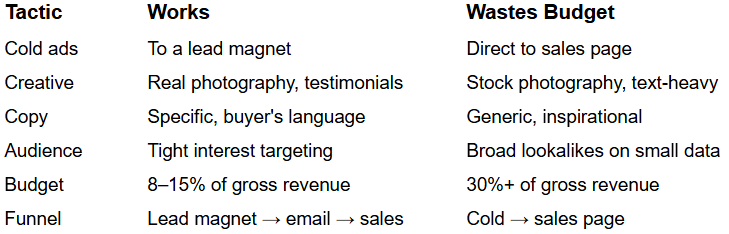
Run ads to a free masterclass, checklist, or guide, not directly to the retreat sales page. Lead magnet opt-in cost: $3–$12 depending on niche.
Layer 2: Retargeting to Sales Page
Once the lead has opted in, retarget them with direct sales page ads over 14–28 days. This is where most deposits come from.
Layer 3: Warm Audience Nurture
Use lower-budget ads to keep the brand in front of the warm audience between launches. Positioning content, testimonials, and behind-the-scenes.
Do not skip to Layer 2 without Layer 1. Direct cold-to-sales-page ads almost always fail for retreats.
What Works vs. What Wastes Budget
How Much to Spend
For a retreat projecting $50,000 in gross revenue, a reasonable ad budget is $4,000–$7,500 across the launch window. Less than that and the data is too thin to optimize. More than that and the business is subsidizing the ad spend.
The 5 Most Common Ad Mistakes
1. Running ads before the organic offer is proven. Ads amplify what works; they cannot rescue what does not.
2. Sending cold traffic directly to the sales page. Conversion is 5–20x lower than via lead magnet.
3. Using stock photography. Retreat buyers pattern-match visual authenticity to credibility.
4. Targeting too broadly. "Wellness" is not a target, "women entrepreneurs scaling to seven figures" is.
5. Optimizing for the wrong metric. Optimize for deposit conversion, not opt-ins or clicks.
Frequently Asked Questions
How long before a retreat should I start running ads?
90–120 days before arrival. This gives enough time for the lead-magnet layer to warm the audience and for retargeting to convert deposits.
Can I run ads without an email list?
Yes, but only through Layer 1 (cold to lead magnet). Ads build the list as they run.
What's a good cost per deposit for a retreat?
For a $4,500 retreat, $150–$400 per deposit is healthy. Above $500, the funnel has issues.
Should I hire an ads agency?
Only after the organic offer is proven. Agencies amplify what works, they cannot diagnose a broken business model.
What if my ads aren't converting?
Audit in this order: positioning, sales page, ad creative, audience targeting, budget. Usually the issue is one of the first two, not the ads themselves.
Want to build a retreat ad funnel that converts? Book a strategy call

Ready to Build a Retreat Business That Matches Your Vision?
Join the free Sold Out & Profitable Masterclass and learn the framework behind retreats that fill and profit consistently.