Strategies for Building a Profitable Retreat Business
Insights on pricing, marketing, hospitality, and the business behind transformational retreats. By Leni Cavazos.
Deposits, Payment Plans, and Refund Policies for Retreat Businesses
Deposits, Payment Plans, and Refund Policies for Retreat Businesses
Deposit size, payment-plan structure, and refund language are three of the highest-leverage decisions in a retreat business, and three of the most commonly mishandled. A well-architected policy suite expands enrollment, protects cash flow, and eliminates the refund requests that kill margin after deposits are already spent on venue. This is the hospitality-grade template.
What Is a Retreat Deposit and Refund Policy?
A retreat deposit and refund policy is the contractual framework that governs how guests secure a seat, when and how they can move or cancel it, and which funds the business is permitted to retain under each scenario.
Deposits: Size and Structure
The Right Deposit Size
The sweet spot is 20–30% of total price. Below 15% signals a low-commitment event and attracts flaky guests. Above 35% creates friction for serious buyers who are still evaluating.
Deposits Should Always Be Non-Refundable
The non-refundable deposit is the single most important clause in a retreat guest agreement. It covers venue deposits, marketing costs, and the founder's time already invested. Guests expect it. It is hospitality-standard.
Deposits Should Be Transferable, Not Refundable
"Non-refundable but transferable" is the magic phrase. It protects the business and gives guests a graceful exi, they can transfer their seat to a friend, the next cohort, or a credit toward a different offer.
Payment Plans: Structure and Safeguards
Every Retreat Needs a Payment Plan
A retreat at $4,500 with no payment plan loses 30–50% of qualified buyers. A payment plan is not a discount, it is an accessibility layer for guests with the budget but not the cash-on-hand.
The Hospitality-Grade Payment Plan Structure
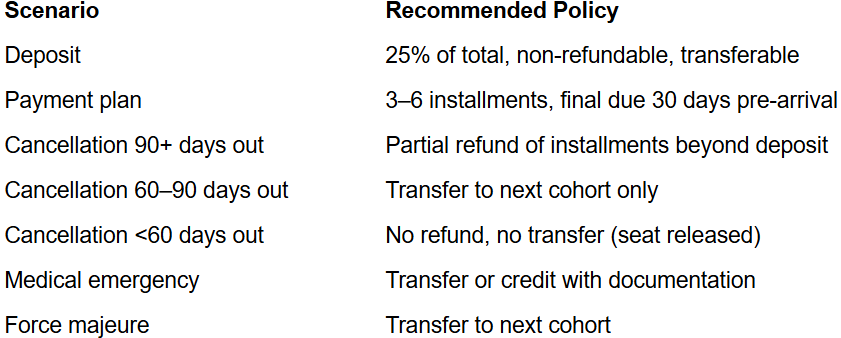
- Deposit (25%) due at booking — non-refundable, secures the seat
- Installments (3–6) spread across the buying window
- Final payment due 30 days before arrival — before venue deposit is due
- Failed payment policy: 72-hour grace, then seat released
Never Allow the Final Installment to Fall Inside the Venue Payment Window
This is the rule that protects cash flow. If the final payment is due after the venue has been paid, a failed payment becomes a loss.
Refund Policies: What to Write, What to Avoid
What to Include
- Non-refundable deposit clause
- Transferability language (next cohort or another guest)
- Medical emergency exception with documentation requirement
- Force majeure clause
- Timeline for any partial refunds (typically 90+ days out only)
What to Avoid
- "Full refund within 30 days" policies — these destroy margin
- Vague language that invites disputes
- Exceptions based on "good faith" — document requirements always
Sample Policy Structures
Frequently Asked Questions
How much should a retreat deposit be?
Twenty to thirty percent of the total price. For a $4,500 retreat, $900–$1,350 is the right range. Lower signals low commitment; higher creates friction.
Can I offer a full refund to keep guests happy?
Don't. A single full refund on a 10-guest retreat can erase the margin on the entire cohort. Offer a transfer or credit instead, guests are almost always satisfied with this.
What if a guest has a true medical emergency?
Build a documented medical exception into the policy. Require a physician's note. Offer a transfer to the next cohort or a credit, not a cash refund.
Do I need a lawyer to write my retreat agreement?
Yes, at minimum to review it once. A one-time legal review typically costs $400–$1,200 and protects the business for years. This is non-negotiable.
Can I change my refund policy mid-enrollment?
Only forward-looking. Guests who booked under a prior policy are protected by it. Apply new terms only to new enrollments.
Need a hospitality-grade retreat agreement template? Book a strategy call to start building your infrastructure.

Ready to Build a Retreat Business That Matches Your Vision?
Join the free Sold Out & Profitable Masterclass and learn the framework behind retreats that fill and profit consistently.