Strategies for Building a Profitable Retreat Business
Insights on pricing, marketing, hospitality, and the business behind transformational retreats. By Leni Cavazos.

Why Business Retreats Outearn Wellness Retreats 3:1
Why Business Retreats Outearn Wellness Retreats 3:1
Business retreats, retreats that serve business-owner guests with a specific professional outcome, outearn wellness retreats by roughly 3:1 on a per-cohort basis, and by even more on lifetime value. The gap is not about topic. It is about buyer economics, continuation revenue, and positioning leverage. This is the breakdown.
What Counts as a Business Retreat?
A business retreat is any retreat whose primary outcome is professional, clarity, strategy, skill, network, or transformation applied to the guest's business. The guest is a founder, operator, executive, or professional. The measurable outcome is what they leave with for their business.
The 3:1 Math
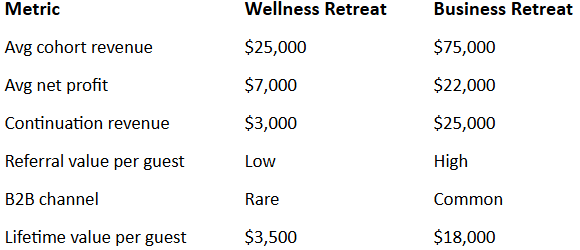
The average profitable wellness retreat earns $8,000–$20,000 per cohort. The average profitable business retreat earns $30,000–$80,000 per cohort. Same venue, same duration, same team size. The gap is not delivery cost, it is revenue.
Why the Gap Exists
1. Business-Owner Buyers Have Bigger Budgets
A founder earning $400K allocates more to professional development than a wellness buyer earning $90K. The price point the business-owner guest tolerates is 2–4x higher.
2. Business Outcomes Justify Higher Prices
"$7,500 for a week that clarified my next 12 months and added $150K in revenue" is a business ROI case. "$2,800 for a restorative week" is a discretionary wellness spend. The first tolerates premium; the second hits a ceiling fast.
3. Continuation Revenue Compounds
Business-owner guests buy follow-on, mastermind, consulting, certification, next-tier retreat. Wellness guests rarely do. The continuation multiplier on a business retreat is 2–4x the retreat revenue itself.
4. Word-of-Mouth Is More Concentrated
Business-owner guests refer inside their professional networks, other founders, other operators. Each referral is high-value. Wellness referrals are broader and lower-value per referral.
5. Corporate and B2B Revenue
Business retreats open a B2B channel, company-paid retreats, executive offsites, custom programs. Wellness retreats rarely do. B2B revenue on a business retreat practice often exceeds cohort revenue over time.
The Side-by-Side Economics
Why This Is Not a Criticism of Wellness
Wellness retreats serve a meaningful purpose. Many of the most gifted retreat leaders in the category started in wellness. The 3:1 gap is not a statement about value to the guest, it is a statement about business economics. Leaders who want to build a hospitality-grade retreat business with strong margins should understand where the margin lives.
Can a Wellness Retreat Become a Business Retreat?
Often, yes. The shift is positioning, not content. A wellness retreat that adds a clear professional outcome, clarity, strategy, leadership, burnout recovery tied to business performance, can reposition into the business-owner tier. The leader may need to add operator credentials or partner with someone who has them.
Frequently Asked Questions
Does this mean I should abandon the wellness category?
No. It means you should understand the economics before choosing your positioning. Some of the most profitable retreat businesses bridge both.
Do business retreats need a corporate background?
Operator credibility helps. Corporate background is one form, entrepreneurship is another. What does not work is zero operator credibility in a business retreat.
What is the simplest path from wellness to business retreat?
Add a specific professional outcome, reposition the page, raise the price, and build a continuation offer. The delivery can often stay largely the same.
Are business retreats harder to fill?
Not at hospitality-grade positioning. The business-owner market is underserved. Filling a 10-person business retreat at $7,500 is often easier than filling a 20-person wellness retreat at $2,800.
Where does the 3:1 number come from?
Aggregate data from 100+ retreat businesses strategized at The Retreat Planner across cohort revenue, continuation revenue, and lifetime value per guest.
Ready to position your retreat business for the 3:1 tier? Book a strategy call

Ready to Build a Retreat Business That Matches Your Vision?
Join the free Sold Out & Profitable Masterclass and learn the framework behind retreats that fill and profit consistently.