Strategies for Building a Profitable Retreat Business
Insights on pricing, marketing, hospitality, and the business behind transformational retreats. By Leni Cavazos.
Are Retreats Profitable? The Real Margins Behind a Sold-Out Retreat Business
Are Retreats Profitable? The Real Margins Behind a Sold-Out Retreat Business
Yes, retreats can be extraordinarily profitable, with net margins of 30% to 50% per cohort when the business model is architected correctly. The reason most retreats lose money has nothing to do with the market and everything to do with pricing fear, venue contracts signed on vibes, and the absence of a continuation offer. The retreat leaders who build real businesses treat every cohort as a profit and loss statement, not a passion project.
The Short Answer, In One Sentence
A retreat is profitable when revenue per guest minus fully-loaded cost per guest clears the margin target set before the venue contract is signed.
What the Real Margin Looks Like
A healthy retreat business targets a net margin of 30% to 50% per cohort. Below 20% is a warning sign. Anything negative means you have built an expensive hobby. To understand why the range is so wide, it helps to see the line items.
For a 10-guest retreat priced at $4,500 per person, total revenue is $45,000. On that number, a well-architected business might spend $9,000 on venue and F&B, $3,500 on flights and ground transport for the leader and team, $2,500 on marketing, $2,000 on staff and assistants, $1,500 on materials and welcome kits, and $1,500 on contingency. Total cost: $20,000. Net profit: $25,000, or 55% margin.
That is what a profitable retreat looks like. The same retreat, with a $1,200-per-room venue instead of a negotiated rate, a last-minute refund policy, and no deposit structure, can drop to a $3,000 loss, on the exact same guest list.
Why Most Retreats Are Not Profitable
They Underprice Out of Fear
The single most common mistake is pricing based on what the leader thinks guests will pay, rather than what the business needs to clear. A retreat priced at $2,500 when it should be $4,500 is not a deal, it is a margin leak that cannot be recovered.
They Sign Venue Contracts Without Negotiating
First-time retreat leaders often accept the first rate the venue quotes. Professional hospitality operators never do this. Every line of the venue contract; F&B minimum, room rate, release clause, staff comp, complimentary upgrades, is negotiable, and each one directly affects net margin.
They Have No Continuation Offer
A retreat without a back-end offer captures a fraction of the revenue it should. The most profitable retreat businesses earn more after the retreat ends, through masterminds, private consulting, or next-tier experiences, than they earn from the retreat itself.
They Count Gross Revenue as Profit
This is the one that produces the most self-deception. "I did $80,000 on my retreat" sounds impressive until you subtract $82,000 in costs.
Profitable vs. Unprofitable Retreats: Side-by-Side Math
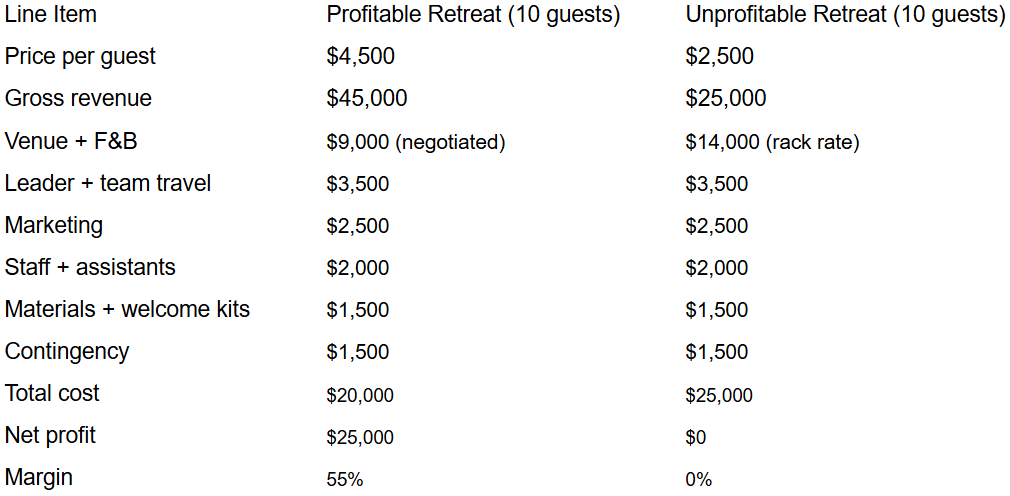
Same guest count. Same delivery. A different business model.
How Much Does a Profitable Retreat Leader Actually Make?
Retreat leaders with a functional business model typically run 2–4 retreats per year plus a continuation offer. At 2 retreats per year producing $25,000 in net profit each, plus a $60,000–$120,000 continuation offer (private consulting, a small mastermind, or a certification track), annual take-home lands in the $110,000–$170,000 range.
Matthew Brandt sold out all three of his summer retreats and built a 76-person waitlist. Tiffany Marshall sold out Silent Serenity with a 100% return rate. Neither of these outcomes happened because the market was hot. They happened because the business was architected to make them repeatable.
Frequently Asked Questions
What is a healthy net margin for a retreat?
Thirty to fifty percent net is the healthy range. Above 50% is excellent and usually signals strong pricing and venue negotiation. Below 20% means the business model needs to be rebuilt before the next cohort.
Can I make a retreat profitable if I only have a small audience?
Yes. A retreat of 8–12 guests at a well-architected price can clear six figures in revenue with a 40% margin. Audience size is not the constraint, enrollment infrastructure is.
Why do retreats in the wellness and yoga space tend to lose money?
Because they are often priced on inspiration rather than margin math. The space has normalized $1,800–$2,500 price points that cannot support a profitable business model in most venues. Profitable retreat leaders in this space price higher, position tighter, and build a continuation offer.
How quickly can I turn an unprofitable retreat business around?
Often in one cohort, if the business model is rebuilt before the next launch. The turnaround involves repricing, renegotiating or replacing the venue, installing a deposit structure, and adding a continuation offer. A single restructuring has produced $27,000 swings on retreats that were headed for losses.
Do I need to charge $5,000 or more to be profitable?
Not necessarily, but below $3,000 per guest the math gets very difficult unless you run large cohorts or use a venue you already own. The higher the price, the more forgiving the cost structure, and the more hospitality-grade the experience can be.
Want to audit whether your retreat business can actually be profitable? Download the free retreat checklist or book a strategy call.

Ready to Build a Retreat Business That Matches Your Vision?
Join the free Sold Out & Profitable Masterclass and learn the framework behind retreats that fill and profit consistently.