Strategies for Building a Profitable Retreat Business
Insights on pricing, marketing, hospitality, and the business behind transformational retreats. By Leni Cavazos.
Why Your Retreat Isn't Selling (It's Probably the Price)
Why Your Retreat Isn't Selling (It's Probably the Price)
When a retreat isn't selling, most leaders blame marketing, audience size, or the algorithm. In reality, the cause is almost always pricing, specifically, a price that is misaligned with the positioning, the cost structure, or the buyer psychology of the audience. This post walks through the six most common pricing failures that stall enrollment, and what to fix first.
What Does "Pricing Is the Problem" Actually Mean?
A pricing problem is any situation in which the number on the sales page creates friction the marketing cannot overcome, either because it signals the wrong value, violates the buyer's psychology, or does not match the positioning of the offer.
The 6 Pricing Failures That Kill Retreat Enrollment
1. Priced Too Low for the Transformation
Counterintuitive, but the most common failure. A $1,800 retreat promising a six-figure business transformation triggers suspicion, not excitement. Premium buyers pattern-match price to credibility.
2. Priced Too High for the Position
The mirror problem. A $9,000 retreat with a generic sales page, no testimonials, and an amateur venue photo will not sell at any price. The number is correct for the margin; the positioning is wrong for the number.
3. No Anchor or Contrast
A single price with no reference point forces the buyer to decide in a vacuum. Profitable retreat sales pages almost always include an anchor, a higher-tier option, a comparison to a prior retreat, or a value breakdown, that makes the chosen price feel like the obvious choice.
4. Payment Plan Missing or Punitive
A $5,000 price with no payment plan loses 30–50% of qualified buyers who cannot clear the full amount before deposit. A payment plan that is only available at a 15% surcharge does the same.
5. Deposit Too Low or Too High
A $100 deposit signals a low-commitment event. A $2,500 deposit on a $4,500 retreat scares off buyers who are still evaluating. The sweet spot is typically 20–30% of total price.
6. No Urgency or Scarcity Architecture
Pricing lives inside a buying window. If guests believe the price will be the same tomorrow and next month, they will wait. Early-bird tiers, cohort caps, and payment-plan deadlines create the buying window, and the window is what makes the price work.
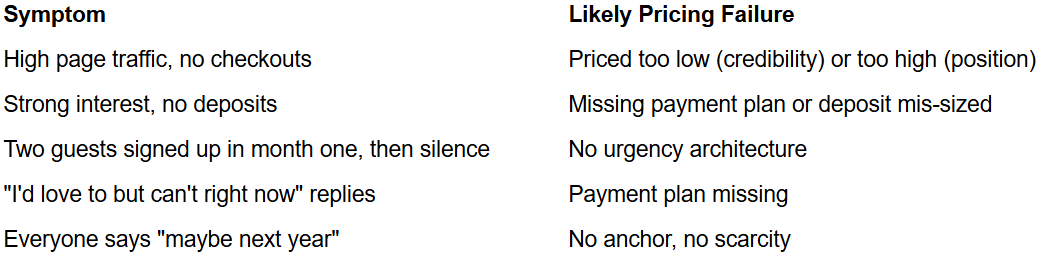
Symptoms and Diagnoses
How to Diagnose in One Hour
1. Audit the sales page against the six failures above.
2. Ask five past guests or qualified leads what would have made it a "yes."
3. Review the last 10 DMs or email replies for pricing language.
4. Compare your positioning and assets to the top three retreats in your category.
5. Fix the single highest-leverage issue first, usually the payment plan or the anchor.
Frequently Asked Questions
Should I just lower the price?
Almost never. Lowering the price signals weakness, trains the market to wait for discounts, and erodes margin. Fix positioning and buying architecture first.
What if I've already announced a price?
You can add a higher-tier option, introduce an early-bird deadline, or restructure payment plans without touching the headline number. All three are more effective than discounting.
How long should I wait before deciding the price is wrong?
If qualified traffic is reaching the sales page and no deposits have come in after 10–14 days, the pricing or positioning architecture needs an audit.
Is a smaller cohort a pricing problem?
Sometimes. A six-guest cap at a $2,500 price almost always signals an under-priced retreat. Raising the price and keeping the cap often increases demand.
Can better marketing solve a pricing problem?
No. Better marketing can amplify a correctly priced retreat. It cannot rescue a mispriced one.
If your retreat is stuck, the fastest path to diagnosis is a strategy call or start with the free masterclass.

Ready to Build a Retreat Business That Matches Your Vision?
Join the free Sold Out & Profitable Masterclass and learn the framework behind retreats that fill and profit consistently.