Strategies for Building a Profitable Retreat Business
Insights on pricing, marketing, hospitality, and the business behind transformational retreats. By Leni Cavazos.
Retreat Profit Margins: What's Healthy, What's Broken, and How to Fix Yours
Retreat Profit Margins: What's Healthy, What's Broken, and How to Fix Yours
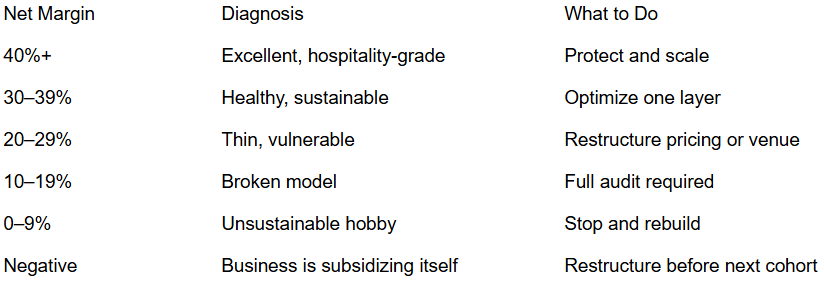
A healthy retreat profit margin sits between 30% and 50% net per cohort. Below 20% is a warning sign, below 10% is a broken business model, and negative margin means the retreat is a hobby funded by the leader. The seven most common profit leaks: underpricing, rack-rate venue contracts, refund policies that cost more than they save, missing continuation offers, uncapped marketing spend, scope creep, and unpaid founder time, can all be audited in under two hours and fixed before the next cohort.
What Is a Healthy Retreat Profit Margin?
A healthy retreat profit margin is the percentage of gross cohort revenue that remains after every line of cost, including venue, travel, marketing, staff, materials, insurance, contingency, and founder compensation, has been paid.
The benchmark ranges a strategist uses to diagnose a retreat business:
The 7 Most Common Retreat Profit Leaks
Leak 1: Underpricing Out of Fear
The single largest profit leak in retreat businesses is pricing set by anxiety rather than math. A retreat priced at $2,500 when the cost structure requires $4,500 to clear a healthy margin cannot be saved by better marketing or a better venue. It can only be repriced.
Fix: Start with the target net profit per guest, add fully-loaded cost per guest, and set price at or above that number. Nothing below it is a business decision.
Leak 2: Signing Venue Contracts at Rack Rate
The first quote from a venue is almost never the best rate. Professional hospitality operators never accept it. Rack-rate contracts can silently consume 15–35% of cohort profit.
Fix: Negotiate F&B minimum, complimentary leader rooms, release clauses, and group discounts. If the venue will not negotiate, find one that will.
Leak 3: Refund Policies That Cost More Than They Save
A generous refund policy feels kind in the moment and destroys margin in aggregate. Every refunded seat that cannot be re-sold before the venue cutoff is pure loss.
Fix: Non-refundable deposits. Payment plans with non-refundable installments. Transferable seats instead of cash refunds. Clear policy language in the guest agreement.
Leak 4: No Continuation Offer
A retreat without a back-end offer captures a fraction of the lifetime value of each guest. This is the highest-leverage fix in most retreat businesses.
Fix: Architect the continuation offer before the first guest books. Present it on-site in the final 48 hours of the retreat, while the transformation is tangible.
Leak 5: Uncapped Marketing Spend
First retreats often overspend on ads to compensate for the absence of an enrollment system. The result is a cohort that filled but did not profit.
Fix: Cap marketing spend at 15% of projected gross revenue. Build organic, podcast, and partnership channels in parallel so that future cohorts cost less to fill.
Leak 6: Scope Creep On-Site
"Can we add an extra excursion?" "Can I upgrade the welcome kits?" "Can we bring in a guest speaker?" Each of these decisions feels small. They compound into 5–15% of margin consumed without any corresponding price increase.
Fix: A fixed delivery scope locked before the venue deposit. Any addition after that point comes out of the contingency line, not the profit line.
Leak 7: Unpaid Founder Time
A retreat that nets $8,000 after 400 hours of founder work is paying the founder $20 per hour. That is not a business, it is a passion project with a receipt.
Fix: Treat founder compensation as a cost line, not a residual. A retreat that cannot pay the founder $75–$150 per hour for time invested is not yet profitable.
How to Audit Your Retreat Margin in Under 2 Hours
1. Pull the last cohort's numbers. Gross revenue, every cost line, founder hours.
2. Calculate true net margin. Include founder time at market rate.
3. Identify the largest cost line. Usually venue, and usually renegotiable.
4. Stress-test pricing. What price would produce a 40% margin on current cost? That is your new floor.
5. Audit refund policy. Is it protecting guests or subsidizing them?
6. Add the missing continuation offer. Price it. Build the on-site conversation for it.
7. Commit to the changes before the next cohort opens for enrollment.
A Real Example
Brent McCann's men's retreat was on track to lose $10,000 the week before he restructured. The audit found four broken lines: underpricing, rack-rate venue, no continuation offer, and no founder compensation. One week of restructuring: repriced the retreat, renegotiated the venue, added a consulting continuation offer, and the same retreat closed at $17,000 in profit. That is a $27,000 swing on the same cohort.
The margin was always there. The business model had to be built to capture it.
Frequently Asked Questions
What is the average net margin for a retreat business?
Across retreats strategized by The Retreat Planner, the average net margin after restructuring is 35–45%. Retreats that have not been restructured typically run 0–15%, or lose money outright.
Is a 20% margin acceptable for a first retreat?
It is survivable but not sustainable. A first retreat at 20% margin usually signals underpricing or venue overspend. Both are correctable before the second cohort.
How do I calculate founder compensation correctly?
Multiply the hours invested in delivery (planning, marketing, on-site, follow-up) by the hourly rate the business would pay a consultant to do the same work, typically $75–$150 per hour for retreat leaders. This number is a cost line, not a profit residual.
What margin should I target for my second retreat?
Minimum 35% net after the first cohort's data has been used to restructure. If the second retreat does not clear that threshold, the business model has a structural issue that coaching cannot fix, it requires strategy.
How fast can a broken retreat be restructured?
Often in a single week, if pricing, venue, refund policy, and continuation offer are all addressed. The restructuring window is before enrollment opens. After deposits are taken, options narrow significantly.
Want to audit your retreat margin with a strategist? Book a strategy call or save your seat in the free masterclass

Ready to Build a Retreat Business That Matches Your Vision?
Join the free Sold Out & Profitable Masterclass and learn the framework behind retreats that fill and profit consistently.