Strategies for Building a Profitable Retreat Business
Insights on pricing, marketing, hospitality, and the business behind transformational retreats. By Leni Cavazos.
How to Price a Retreat: The 5-Step Profit-First Formula
How to Price a Retreat: The 5-Step Profit-First Formula
The right way to price a retreat is to start with the margin you need, work backward through every cost line, and land on a price that produces a profitable business, not one that matches the market average. Most retreat leaders do the opposite: they look at competitors, subtract 10%, and call it a day. That is how retreats lose money at sold-out capacity. The 5-step profit-first formula below is the same math hospitality-grade operators use to protect margin before a single seat is sold.
What Is Profit-First Retreat Pricing?
Profit-first retreat pricing is a pricing methodology that begins with a target net profit per guest and works backward through cost to determine the price floor, the opposite of competitor benchmarking.
It is the difference between running a business and hosting an expensive event.
The 5-Step Profit-First Formula
Step 1: Set the Target Net Profit Per Guest
Decide how much profit the retreat must produce per guest. A healthy retreat business targets $1,200–$3,000 in net profit per guest, depending on price tier.
Step 2: Calculate Fully-Loaded Cost Per Guest
Add every cost line: venue, F&B, travel, marketing, staff, materials, contingency, insurance, and founder compensation, and divide by cohort size. This is your cost floor. Any price below it is a loss.
Step 3: Add a Margin Buffer
Never price at exactly cost + target profit. Add a 10–15% buffer for currency swings, cancellations, and scope creep. This is not optional.
Step 4: Stress-Test Against Positioning
A $6,500 retreat price requires $6,500 positioning. If the sales page, venue photography, and brand cannot carry the number, the math is right but the market will not clear it. Fix the positioning or lower the ambition, not the price.
Step 5: Lock the Floor, Not a Ceiling
Your calculated number is the minimum. Premium positioning can take it higher. Nothing, not a discount, not a payment plan, not a scholarship, goes below it.
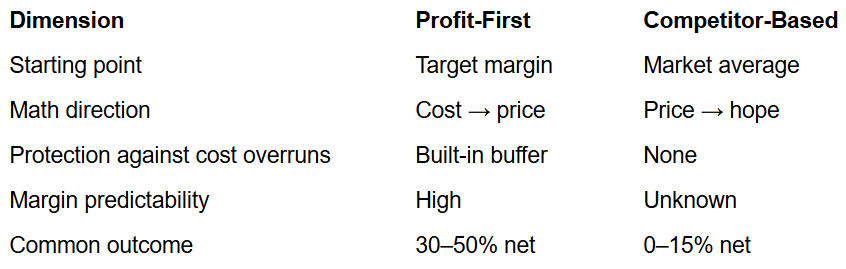
Profit-First vs. Competitor-Based Pricing
Real Pricing Example
A 10-guest yoga-facilitator retreat with $22,000 in fully-loaded costs and a $1,500 per-guest profit target:
- Cost per guest: $2,200
- Target net profit per guest: $1,500
- Buffer (12%): $444
- Price floor: $4,144
Rounding up to a clean $4,250 produces a 36% margin, healthy, sustainable, and defensible.
Frequently Asked Questions
Is there a "right" price for a retreat?
There is no universal number. The right price is the one that clears your target margin on your actual cost structure for your specific positioning. Two retreats in the same market can correctly be priced $3,000 apart.
What if my calculated price feels too high?
It is almost never too high, it is usually the first time the leader has seen what the business actually costs. The fix is stronger positioning, not a discount.
Can I run payment plans at a profit-first price?
Yes, if installments are non-refundable and the final installment clears before the venue deposit is due. Payment plans expand access without eroding margin.
How often should I raise prices?
Every new cohort should be priced against updated cost data. Inflation, venue rate increases, and currency swings all compound. A static price is a shrinking margin.
Does premium pricing reduce demand?
Not in the retreat category. Premium pricing typically attracts more committed guests, fewer refund requests, and higher referral rates. The buyer psychology is: if it is cheap, it probably is not transformational.
Want Leni to architect your retreat price with you? Book a strategy call

Ready to Build a Retreat Business That Matches Your Vision?
Join the free Sold Out & Profitable Masterclass and learn the framework behind retreats that fill and profit consistently.