Strategies for Building a Profitable Retreat Business
Insights on pricing, marketing, hospitality, and the business behind transformational retreats. By Leni Cavazos.
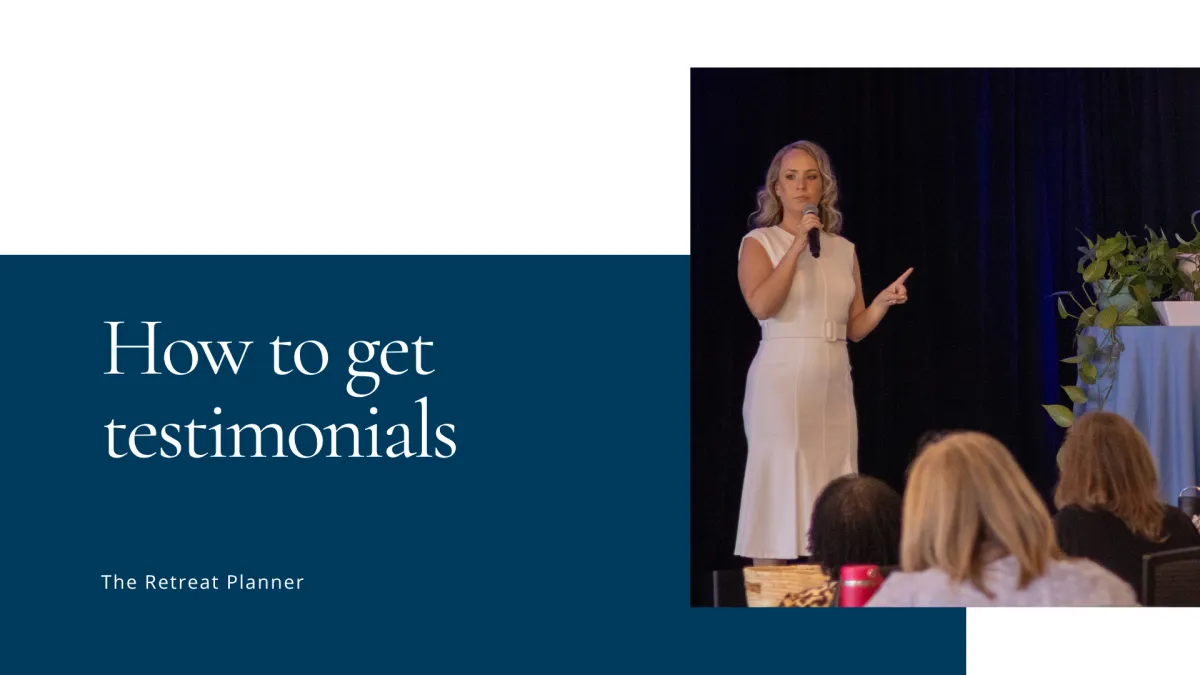
How to get testimonials
How to Use Testimonials to Sell Your Retreat Without Feeling Salesy
Testimonials are often treated as an afterthought.
They’re something retreat leaders remember at the end, when the retreat is over, people are leaving, and there’s a quick attempt to capture a few nice words before everyone disappears.
But testimonials are not just a “nice to have.”
They are one of the most powerful tools you have to build trust, credibility, and long-term loyalty in your retreat business.
Because when someone is deciding whether to join your retreat, they are not just listening to you.
They are listening to the experience of someone who has already been there.
Why Testimonials Matter More Than You Think
Testimonials are not about praise.
They are about proof.
When potential clients are considering your retreat, they are asking themselves:
Will this actually work for me?
Is this experience real?
Can I trust this person?
And while your messaging can answer those questions, testimonials validate them.
They allow people to see themselves in someone else’s journey.
This is where testimonials become part of what I call loyalty marketing, because they don’t just help you sell once. They help you build a reputation that continues to attract aligned clients over time.
Why Video Testimonials Are the New Standard
Written testimonials still have value.
But today, video testimonials have become significantly more powerful.
Why?
Because we live in a time where content can easily be manipulated.
With AI, it’s possible to:
generate fake names
create fake photos
write convincing testimonials
But video is still much harder to fake in a way that feels real.
When someone watches a video testimonial, they are not just reading words.
They are experiencing:
tone of voice
body language
emotion
authenticity
That creates a level of trust and credibility that written testimonials alone cannot match.
And the best part is: you can always repurpose video into written form later.
But you cannot do the opposite.
When to Ask for a Testimonial (Timing Matters)
One of the biggest mistakes retreat leaders make is waiting too long.
The power of a testimonial comes from emotion.
From the feeling someone has right after transformation happens.
If you wait too long:
the intensity fades
the details become less clear
the emotional connection weakens
That’s why testimonials should be collected:
during the retreat (if appropriate)
at the end of the experience
shortly after, while the transformation is still fresh
However, timing is not just about speed, it’s also about sensitivity.
For example:
Asking right at the door when someone is leaving → too rushed
Asking at the very beginning → too early
Asking when the experience has fully landed → ideal
You want to capture the moment where the experience is still alive in their body, but they have had enough time to process it.
Don’t Just “Ask”, Guide the Testimonial
Most people don’t naturally give strong testimonials.
Not because they didn’t have a powerful experience, but because they don’t know how to express it.
This is where most testimonials fall flat.
You’ll often hear things like:
“It was amazing”
“I loved it”
“It was great”
But these statements don’t help future clients understand anything meaningful.
This is why guiding the testimonial is essential.
The Simple Shift That Changes Everything
Instead of asking:
“How was your experience?”
You guide them into a complete answer.
For example:
“Can you share how you felt when you experienced [specific moment]?”
And even more importantly, you prompt them to answer in a full sentence.
Instead of:
“I felt amazing”
You guide them toward:
“When I experienced this retreat, I felt…”
This small shift makes a huge difference.
Because now, when you edit or repurpose the testimonial, it stands on its own.
It has context. It has clarity. It has meaning.
What Makes a Testimonial Actually Work
A testimonial is not a sales pitch.
And this is a very important distinction.
Sometimes, clients are so excited about their experience that they start promoting you instead of sharing their journey.
While this comes from a beautiful place, it’s not what makes a testimonial effective.
The most powerful testimonials focus on:
1. The Before
What was happening in their life before the retreat?
2. The Experience
What did they feel during the retreat?
3. The Transformation
What changed as a result?
This is what allows future clients to connect.
Because they are not looking for hype.
They are looking for evidence of transformation.
Testimonials Are Emotional, Not Logical
Many retreat leaders approach testimonials like surveys.
They ask questions such as:
Did you like the location?
Was the food good?
Were the sessions helpful?
These are useful, but they belong in feedback forms.
Testimonials, on the other hand, are about:
feelings
shifts
realizations
breakthroughs
They answer questions like:
How did this experience impact you?
What changed for you?
What are you taking with you after this retreat?
Because ultimately, people don’t buy retreats for logistics.
They buy them for transformation.
You Can Guide Without Manipulating
There is a misconception that guiding testimonials means controlling what people say.
It doesn’t.
You are not telling them what to say.
You are helping them express what they already experienced in a way that is clear and meaningful.
This is the difference between:
forcing a message
facilitating clarity
When done correctly, testimonials remain authentic while also becoming far more impactful.
Testimonials as a Return of Value
Many retreat leaders feel uncomfortable asking for testimonials.
But here’s a powerful reframe:
When someone experiences real transformation, they often want to give something back.
A testimonial becomes:
a way for them to express gratitude
a way to share their experience
a way to support your work
It’s not a transaction.
It’s an exchange.
And when the transformation is genuine, people are usually more than willing to share it.
Testimonials are not just content.
They are a bridge between your work and your future clients.
When done well, they:
build trust
communicate transformation
increase conversions
strengthen client loyalty
If you want your retreats to fill with aligned participants, don’t leave testimonials to the last minute.
Design them intentionally.
Guide them thoughtfully.
Capture them at the right time.
Because the way your clients share their experience will often determine whether someone else decides to step into it.

Ready to Build a Retreat Business That Matches Your Vision?
Join the free Sold Out & Profitable Masterclass and learn the framework behind retreats that fill and profit consistently.